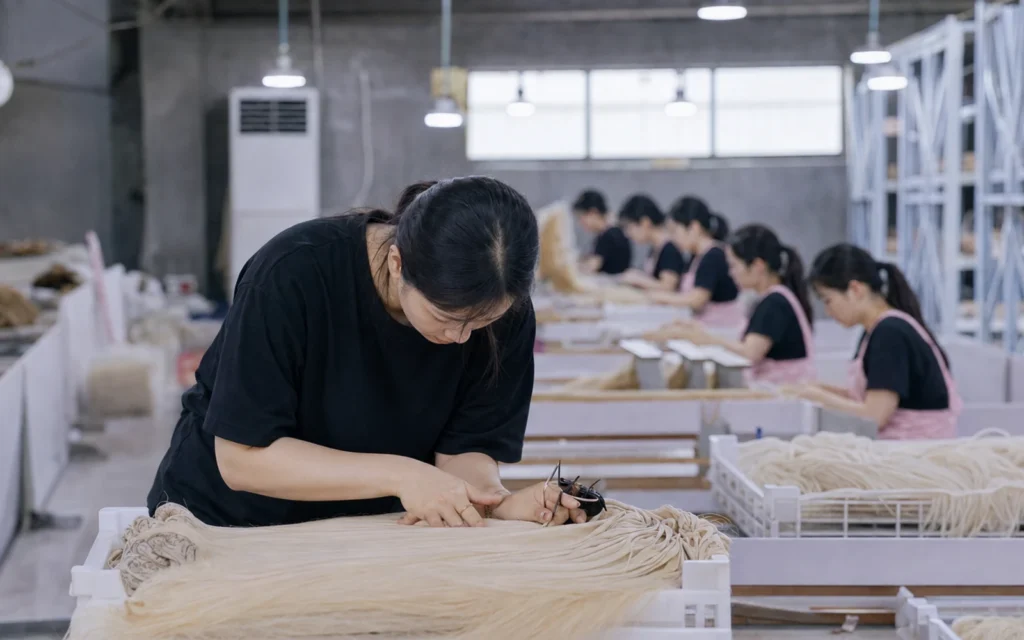
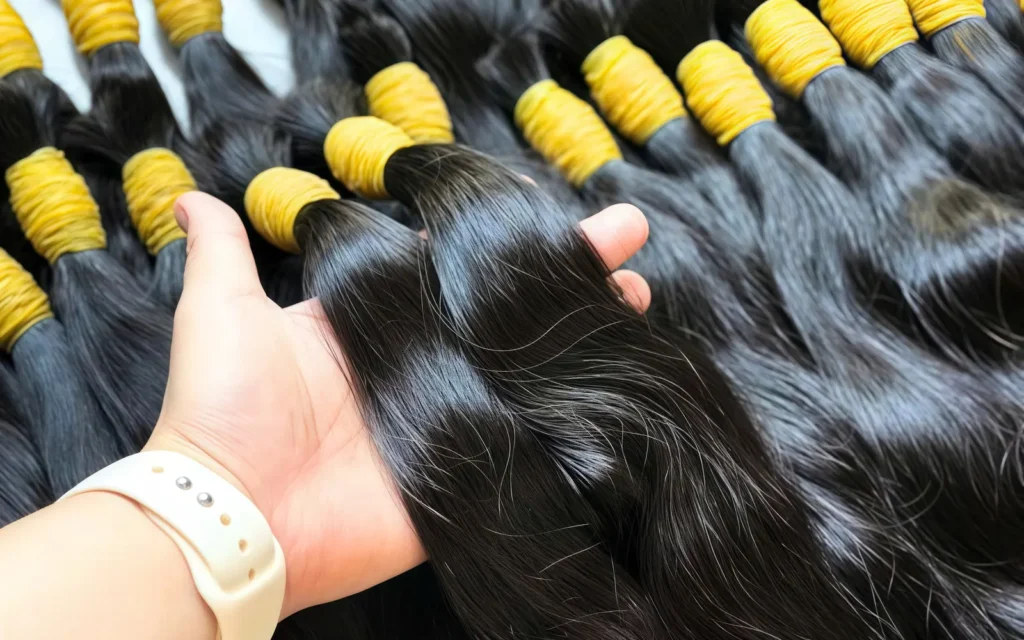
Virgin hair vs Remy hair is often presented as a simple quality ranking. For professional buyers, that approach is too vague. The two terms describe different parts of a hair specification.
Virgin Hair mainly describes processing history. Remy Hair mainly describes root-to-tip alignment and how the hair is handled. Those characteristics can overlap, but they are not interchangeable.
A buyer should therefore ask a more useful question: what does each term mean in the supplier’s actual production system? The answer should connect the label to material selection, processing, color capability, construction, testing, and repeat-order control.
Start With Two Different Definitions
When comparing Virgin Hair and Remy Hair, separate processing history from fiber direction. This prevents one marketing label from standing in for the whole product specification.
What Virgin Hair Describes
Virgin Hair generally refers to hair that has not undergone chemical color or texture processing before selection for the intended product. The key point is its processing history.
That does not automatically define every other quality factor. Buyers still need to check cuticle direction, sorting, length distribution, color plan, construction, and finished performance.
What Remy Hair Describes
Remy Hair refers to hair kept in a consistent root-to-tip direction. This alignment helps reduce opposing cuticle direction within the finished product.
However, Remy does not tell you the full chemical history. Remy hair may still pass through color, texture, washing, or finishing processes.
For that reason, Remy should not be treated as a complete grade. It is one controlled characteristic within a larger hair specification.
Virgin Hair vs Remy Hair: A Buyer Comparison
| Buying Factor | Virgin Hair | Remy Hair |
|---|---|---|
| Primary meaning | Processing history | Root-to-tip direction |
| Chemical processing | Should be clarified and documented | May vary by product and shade |
| Cuticle direction | Must still be confirmed | Direction control is a defining requirement |
| Color capability | Depends on starting hair and approved processing route | Depends on starting material and later processing |
| Finished performance | Must be tested on the actual product | Must be tested on the actual product |
| Best procurement approach | Define the processing history and finished specification | Define direction control and the finished specification |
The table shows why the two terms should not be treated as opposites. They answer different sourcing questions.
Do Not Turn Hair Labels Into a Universal Grade System
Terms such as premium, luxury, 10A, 12A, Virgin, and Remy can sound precise. In practice, suppliers may use them differently.
A professional buyer should therefore avoid comparing suppliers by label alone. Instead, ask each supplier to define the product in measurable terms.
For example, two suppliers may both quote Remy hair extensions. One may use a different starting material, color route, length distribution, or finishing process.
The same problem can occur with Virgin Hair. A shared label does not guarantee an identical product.
For sourcing purposes, the useful question is not, “Which grade sounds higher?” Ask, “Which specification can this factory reproduce?”
Processing History Matters Because Processing Changes Hair
Hair extension production may involve washing, lightening, coloring, texture development, drying, conditioning, and finishing. Each stage can affect the fiber.
The impact depends on the starting hair and the exact process. It also depends on how the factory controls time, chemistry, handling, and finishing.
Heavy processing can create more risk than a gentler route. Therefore, buyers should ask about the route used for the actual shade and texture.
An academic study of excessively bleached hair documented cuticle and internal structural changes after aggressive bleaching. That evidence does not mean every colored extension performs poorly. It simply supports a practical sourcing point: processing intensity matters.
This distinction is especially important for light shades. A blonde product and a dark product may begin with different material requirements or processing routes.

Cuticle Direction Is Important, but It Is Not the Whole Story
Consistent root-to-tip direction is an important part of Remy control. Mixed direction can increase surface interaction between fibers.
Still, direction alone does not determine finished performance. Processing, residue, texture, construction, care, and mechanical stress also matter.
That is why a Remy label should lead to process questions rather than end the discussion. Buyers should ask how direction is preserved.

Questions About Direction Control
- How does the factory identify root and tip direction?
- Which stages create the greatest risk of mixing direction?
- How does the team preserve direction during wet processing?
- How is direction maintained during product construction?
- What checks are used before packing?
Clear answers should describe handling and control. A short statement such as “all our hair is Remy” is not enough.
Color Range Should Not Be Used as a Shortcut for Quality
Buyers sometimes assume that Virgin Hair must offer every color without processing. That assumption creates confusion.
Finished color is a separate product decision. The factory must match the starting material and processing route to the approved shade.
A brand may need natural shades, rooted colors, highlights, balayage, or very light blondes. Those requirements can change the production route.
For that reason, ask how the proposed hair category supports your actual color collection. Do not approve the category before reviewing the shade plan.
Also compare color performance on finished products. The same shade can appear different across lengths, textures, and attachment structures.
Finished Performance Matters More Than the Label
A buyer does not sell an incoming hair label. The buyer sells a finished extension that customers wash, brush, style, install, and wear.
Therefore, the final product needs its own approval process. Hair category alone cannot prove finished performance.
Test the exact combination of hair, shade, texture, length, fullness, attachment structure, and finishing process. That combination becomes the commercial product.
Performance Questions to Include in Sample Review
- How does the hair feel before and after washing?
- Does wet or dry combing reveal unusual resistance?
- Does the approved texture change as expected after washing?
- Does the shade remain within the agreed reference?
- Does the attachment structure remain secure?
- Does the sample match the agreed length and weight basis?
- Does the finished product match the approved visual standard?
Use the same test method when comparing suppliers. Otherwise, the results are difficult to interpret.
Separate Hair Quality From Drawn Level
Single drawn and double drawn describe length distribution. They do not replace Virgin or Remy definitions.
A Virgin Hair product can use different fullness specifications. The same is true for a Remy Hair product.
This distinction matters because buyers often combine several labels into one vague quality description. That makes later reorders harder to control.
Instead, record hair category and length distribution as separate specification fields. Also record finished weight and the approved visual result.
Raw-Hair Origin Is Not a Complete Quality Specification
Origin can be part of a sourcing discussion, but it should not become the entire quality definition. Material from one region can vary.
Sorting, diameter, texture, processing history, color route, and construction all affect the finished result. The factory must control those variables.
For that reason, buyers should avoid simple origin rankings. Ask how the actual incoming material is selected for the approved product.
Turn the Hair Label Into a Written Specification
The most useful result of a Virgin Hair vs Remy Hair discussion is a clearer product specification. That document should travel from sampling into bulk production.
At minimum, record the following information.
- Hair category and the supplier’s operational definition.
- Relevant processing history.
- Root-to-tip direction requirement where applicable.
- Approved color and texture.
- Finished length and weight basis.
- Long-hair ratio or drawn-level requirement where relevant.
- Attachment or product construction.
- Approved sample reference.
- Testing method and acceptance criteria.
- Packaging and labeling requirements.
This approach turns a marketing term into a production instruction. It also gives quality teams something concrete to inspect.
Compare Suppliers on the Same Product Brief
A fair supplier comparison requires a common brief. Do not request one product from Supplier A and a different specification from Supplier B.
First, define the target hair category. Next, align color, texture, length, fullness, construction, and finished weight.
Then use the same test plan. This makes differences between samples more meaningful.
Price comparison should come after specification alignment. Otherwise, a cheaper quotation may simply reflect a different product.
Questions to Ask Before Approving Virgin or Remy Hair
- How do you define Virgin Hair for this product?
- How do you define Remy Hair for this product?
- Which processing steps occur before the finished product is approved?
- How do you preserve root-to-tip direction where required?
- Which starting material is used for the target shade?
- How does the color route change between darker and lighter shades?
- How are different incoming hair groups separated?
- Which finished-product tests are used during sampling?
- How is the approved sample transferred into bulk production?
- How do repeat orders reference the original approved standard?
The strongest answers connect terminology to real process controls. They should also match what the finished sample demonstrates.
Which Option Should a Brand Choose?
There is no useful universal rule that every brand should choose one label. The right direction depends on the product strategy.
A brand may prioritize processing history, color flexibility, root-to-tip control, price positioning, or a specific finished performance target.
Start with the customer promise. Then define the material and manufacturing controls needed to support that promise.
For some collections, Virgin Hair may fit the target specification. Other collections may use Remy Hair with an approved processing route.
In both cases, sample validation matters. The buyer should approve the finished product rather than rely on terminology alone.
A Practical Buyer Decision Framework
| If Your Priority Is | What to Confirm |
|---|---|
| Minimal prior processing | Supplier definition of Virgin Hair and documented processing history |
| Root-to-tip alignment | Remy direction control from incoming hair through construction |
| Complex color collection | Starting material, shade-specific processing route, and physical color approval |
| Consistent reorders | Retained samples, written specifications, batch records, and change control |
| Reliable customer experience | Finished-product testing under the intended use and care conditions |
This framework keeps the discussion focused on evidence. It also helps buyers compare quotations without relying on vague grades.
Build Your Quality Position Around a Repeatable Standard
Virgin Hair and Remy Hair can both support professional hair extension collections. The label alone does not create the final quality position.
Instead, quality comes from a controlled combination of material, processing, color, construction, testing, and repeatability.
Epoche supplies both Virgin Hair and Remy Hair options across its human hair extension range. Our team can align the hair category with the intended product specification.
We also connect approved samples with production controls through our manufacturing process.
Need to compare hair options for a new collection? Request samples and share your target products, shades, textures, lengths, and quality position.
Frequently Asked Questions
Is Virgin Hair Always Better Than Remy Hair?
No. Virgin and Remy describe different characteristics. Buyers should compare the complete product specification and finished sample.
Can Hair Be Both Virgin and Remy?
The concepts can overlap because processing history and root-to-tip direction are separate characteristics. Always ask how the supplier defines each term.
Does Remy Hair Mean the Hair Has Never Been Colored?
No. Remy mainly refers to direction control. The chemical and color history must be confirmed separately.
Does Virgin Hair Guarantee a Fixed Lifespan?
No. Product performance depends on many variables, including processing, construction, care, installation, and use. Test the actual finished product.
Should Buyers Compare Hair by Origin?
Origin can be one sourcing factor, but it is not a complete quality specification. Processing, sorting, color, and construction also matter.
What Should a Buyer Approve Before Bulk Production?
Approve the written specification, finished sample, color and texture references, construction details, and testing method. Keep a controlled reference for reorders.