Receiving a soft, glossy sample does not answer the most important sourcing question: will the product still meet your standard after washing, installation, removal, and repeat production? For a B2B buyer, learning how to test hair extension quality means replacing first impressions with a controlled, documented comparison.
This guide gives brands, distributors, importers, and product teams a practical sample-testing process before a bulk order. It covers hair performance, color, weight, construction, attachment-specific checks, and the approved control sample that should govern production.
Use a Three-Layer Test Protocol
A useful test separates the sample into three evidence layers:
- Specification: confirm that the sample is the product you requested—correct construction, length, weight, shade, texture, and attachment details.
- Performance: wash, dry, brush, style, install, and remove it under recorded conditions that reflect your intended market.
- Repeatability: compare more than one piece, approve a labeled physical control sample, and verify the pilot or bulk lot against that standard.
The goal is not to make a sample survive an extreme test. The goal is to reproduce the way your customer will use the product, identify failure risks, and create evidence for a clear approve, revise, or reject decision.
1. Write the Test Plan Before Opening the Samples
If several suppliers are being compared, assign each sample a code and evaluate them against the same protocol. Do not let price, packaging, or a familiar supplier name influence the first technical assessment.
Create a sample record with:
- Supplier and internal sample ID.
- Product type and construction.
- Claimed hair quality and processing information.
- Color, length, texture, finished weight, and attachment specification.
- Date received and sample version.
- Tester, test conditions, products used, and photo references.
- Required result, actual result, and decision.
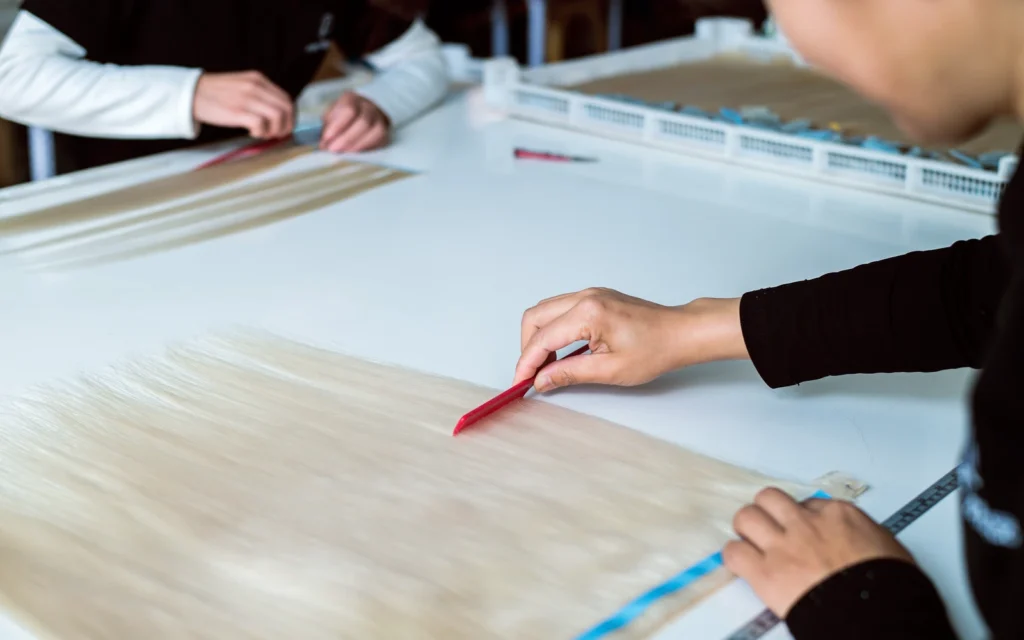
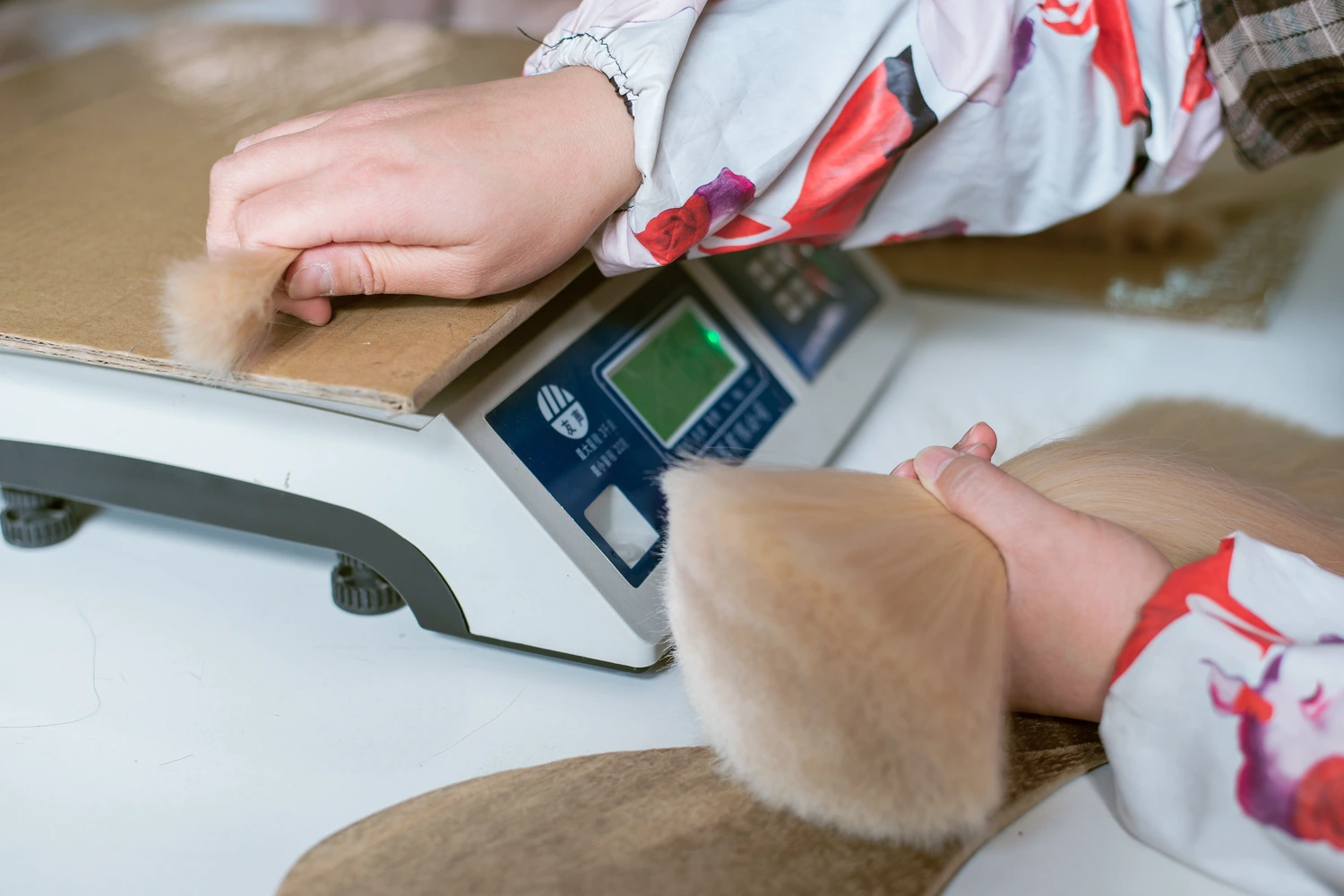
Photograph the unopened sample, its labels, and its packaging. Then weigh and measure it before washing. If the order specification defines a particular measurement method—for example, stretched length for a textured product—use the same method every time.
Do not invent acceptance limits after seeing the result. Decide in advance which characteristics are critical to your brand, what variation is acceptable, and what requires a new sample.
2. Standardize the Variables That Can Distort the Result
Two samples cannot be compared fairly if one is washed in hot, hard water and another in cool, soft water, or if different shampoos, brushes, drying methods, and heat settings are used.
Record and keep consistent:
- Water temperature and, when relevant, water hardness.
- Shampoo and conditioner, including amount and contact time.
- Washing motion, rinse time, and towel-drying method.
- Air-drying or blow-drying method.
- Brush or comb type and detangling sequence.
- Heat tool and temperature, if heat styling is part of the test.
- Number of wash, dry, and styling cycles.
- Installation tools, replacement tape or bond system, and remover.
The protocol should reflect the care instructions and performance claims you intend to give customers. There is no universal number of washes or one temperature that proves every extension is good. A premium professional range, an occasional-wear clip-in set, and a daily-wear salon product may need different protocols.
3. Complete a Dry Baseline Inspection
Inspect the sample before applying water or heat. This establishes the condition in which it arrived and helps you distinguish an original defect from a change caused by testing.
Confirm specification and workmanship
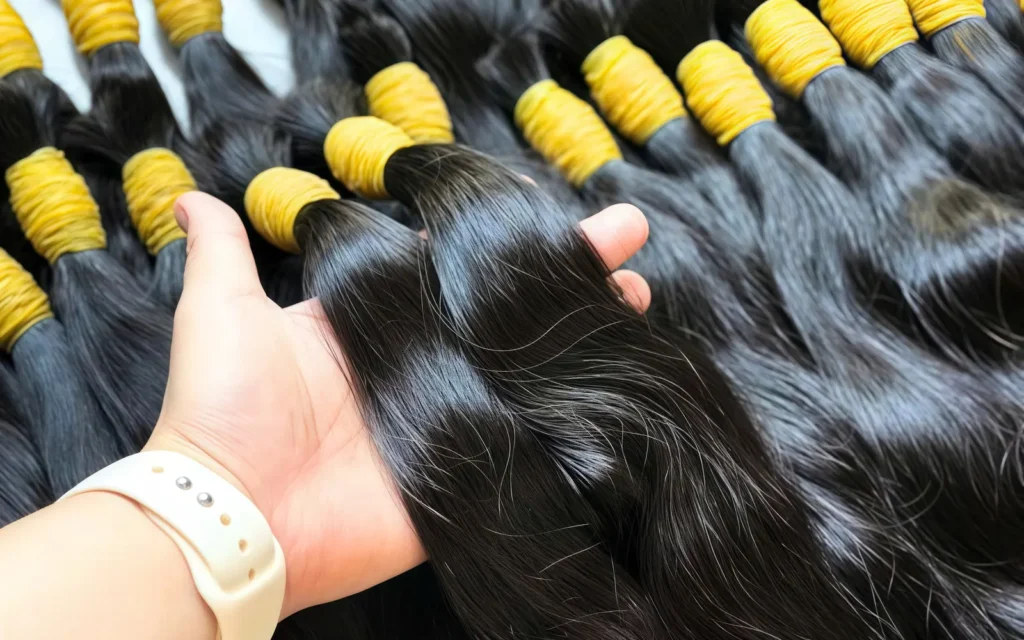
Check the finished length, weight, shade, texture, end fullness, and construction against the written specification. Look at the top, middle, and ends rather than judging only the most visible area.
For color, compare the sample with the approved physical reference or hair extension color ring under consistent daylight and controlled indoor lighting. Record undertone, root length, blend, and any top-to-end variation. A phone photograph is useful for documentation, but it should not replace the physical reference.
Establish the starting condition of the hair
Run clean fingers through the hair and use the approved brush or comb. Note tangling, snagging, static, visible short hairs, shedding, odor, surface residue, and whether the softness feels natural or heavily coated.
Do not rely on a burn test to confirm human hair, and do not treat extreme bleaching as a universal quality test. These methods can be hazardous, inconsistent, and easy to misinterpret. If fiber identity, restricted substances, or chemical safety must be verified, use a qualified laboratory and specify the required test method.
4. Run a Controlled Wash-and-Dry Test
Washing is useful because it removes some temporary finishing effects and shows how the hair behaves in a condition closer to actual use.
Before washing, gently detangle the sample and secure the attachment area as it would be handled in use. Wash in one direction without scrubbing the hair into a ball. Observe the water and a white towel for unusual color transfer, but interpret the result according to the shade and the agreed product claim. A processed dark or fashion shade cannot be assessed by the same expectation as an untreated natural color.
During and after washing, record:
- Tangling or matting while wet.
- Shedding and broken strands.
- Change in texture or curl pattern.
- Change in color, undertone, or top-to-end uniformity.
- Slippery residue or a sudden loss of softness after finishing products rinse away.
- Drying behavior, frizz, static, end condition, and ease of detangling.
- Whether the hair returns to the approved appearance after the specified care routine.
Collect loose strands in the same way for every sample. A strand count can be useful only when the starting weight, construction, handling, and collection method are controlled. Avoid publishing a pass/fail number that has no relationship to the product structure or test method.
If heat styling is relevant, test only within the stated care temperature. Record the tool, setting, contact time, and number of passes. Assess not only the immediate styled result but also the condition after the next wash.
5. Test the Attachment and Construction Separately
Good hair cannot compensate for an attachment that slips, delaminates, sheds, feels uncomfortable, or leaves excessive residue. Use a qualified installer and the intended professional system for application and removal.
| Product | What to inspect before installation | What to test in use and removal |
|---|---|---|
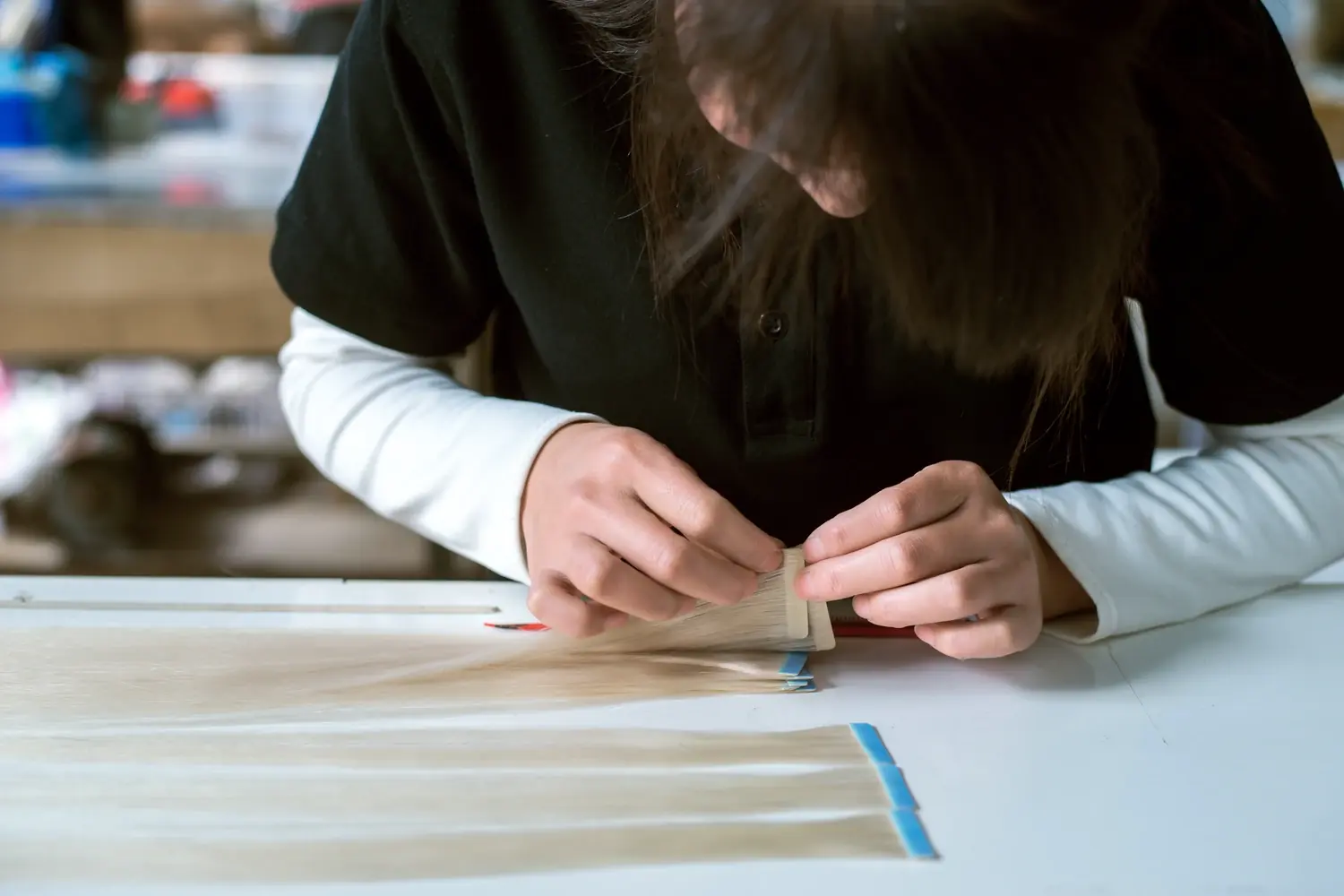
| Tape-In Hair Extensions | Tab dimensions, hair distribution, edge finishing, PU or injected area, adhesive coverage, liner application, air pockets, and pair consistency | Bond formation, slippage, lifting, delamination, shedding, removal control, residue, and whether the base remains intact with the approved remover and retaping system |
| Weft Hair Extensions | Weft width, base thickness, flexibility, stitching or bonded structure, uniform hair distribution, loose fibers, and top shedding | Sewing or bead installation behavior, comfort, shedding, base distortion, and the approved cut-and-seal method; cut requirements vary by weft construction and must be documented |
| Keratin Tip Hair Extensions | Bond shape, size, weight distribution, hair alignment, consistency between strands, and visible cracks or contamination | Softening and forming behavior with the intended connector, bond integrity, slippage, shedding, comfort, controlled removal, and residue with the approved remover |
| Clip-In Hair Extensions | Set composition, weft widths, clip count and spacing, stitching, base visibility, clip coating, teeth, and weight distribution | Opening and closing, grip, comfort, lay against the head, concealment, repeated handling, and shedding at the clip and seam areas |
Do not force one pass/fail rule across all four categories. Even within one category, different structures may require different handling. The approved specification must state the exact product being tested.
6. Compare Multiple Pieces, Not One Hand-Selected Sample
A single sample can show whether a product direction is promising; it cannot demonstrate batch consistency. Request enough pieces to compare variation within the same shade, length, and construction. When your collection includes several lengths or attachment systems, check whether the same shade remains commercially consistent across them.
Use the sample stage to answer three separate questions:
- Can the supplier make the intended product once?
- Can it make several pieces consistently?
- Can the same standard be transferred into a pilot and bulk production run?
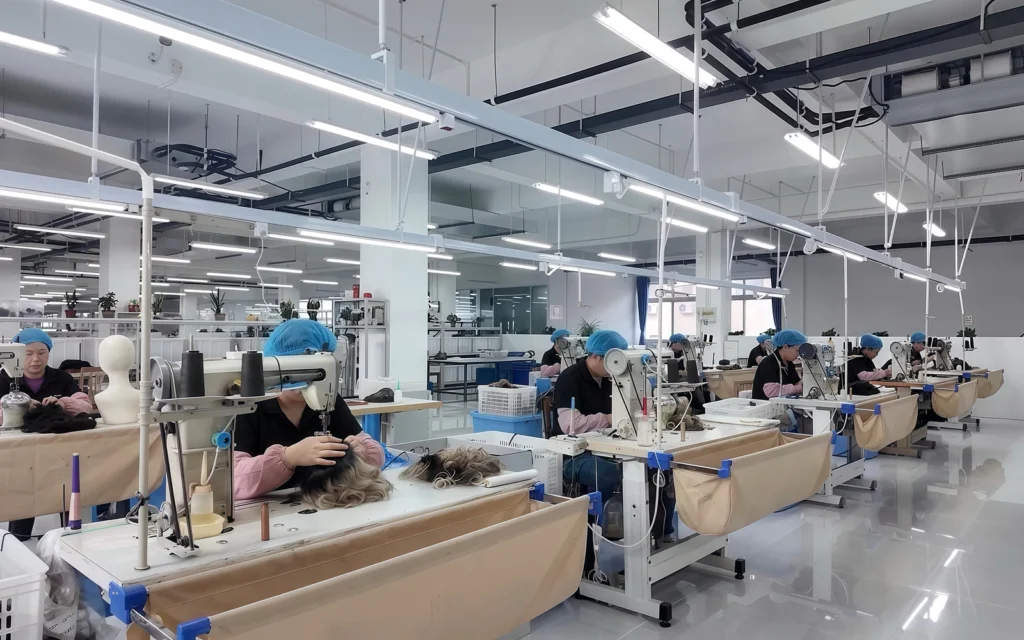
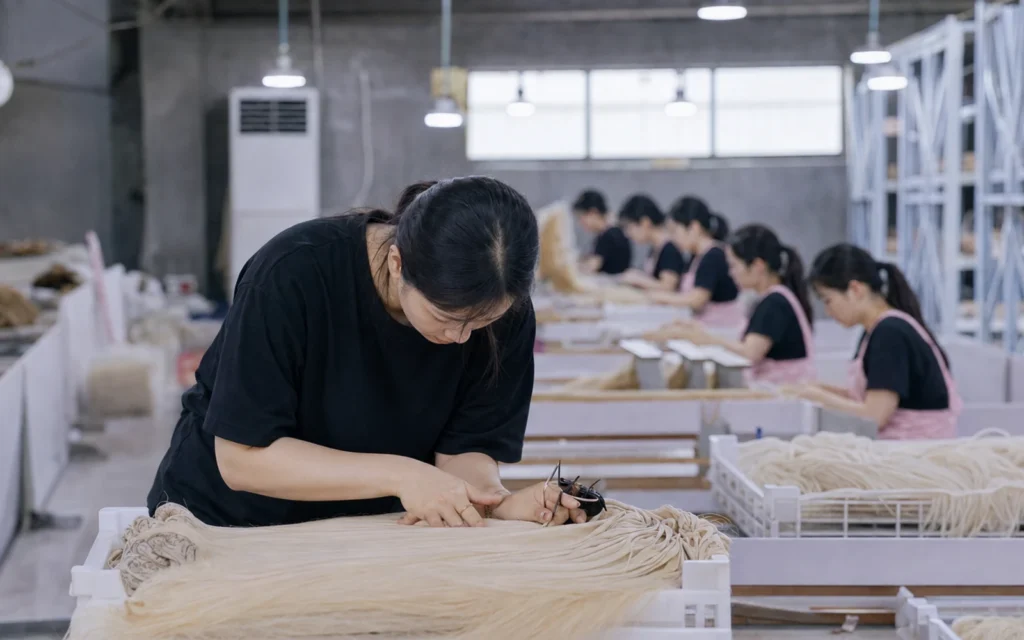
The third question requires production evidence. Review the supplier’s manufacturing and quality approach, agree on measurable specifications, and use a pilot order when the commercial risk justifies it.
7. Create an Approved Control Sample
When a sample passes, do not simply tell the supplier that it “looks good.” Turn it into a controlled reference.
Label the approved sample with:
- Product name or SKU and specification version.
- Color, length, weight, texture, and construction.
- Approval date and approver.
- Sample or development number.
- Any approved deviation or special handling instruction.
Keep one approved sample untouched whenever possible and use a separate piece for destructive or repeated testing. The manufacturer should retain a matching sample or equivalent controlled reference. Store both away from strong light, heat, moisture, and contamination.
The approval record should also include photographs and measurements, but those records do not replace the physical sample. This retained standard becomes the comparison point for pre-production confirmation, the pilot order, bulk inspection, claims, and repeat orders.
8. Use a Clear Approve, Revise, or Reject Decision
Avoid vague comments such as “make it better,” “less dry,” or “more premium.” Translate observations into a requirement the product team and manufacturer can act on.
| Decision | Use it when | Required next step |
|---|---|---|
| Approve | The sample meets the written specification and the recorded performance protocol | Sign and retain the control sample; confirm the production specification and packaging version |
| Revise | The product direction is acceptable, but one or more defined points need correction | Issue a numbered comment sheet; request a new version and retest the affected characteristics |
| Reject | A critical requirement fails, performance is unsuitable for the intended market, or the result cannot be reproduced reliably | Close the sample version or redefine the product before further development |
For revisions, change one variable at a time where practical. If hair quality, color, weight, bond formulation, and packaging are all changed together, it becomes difficult to identify which change caused the new result.
Epoche’s OEM, ODM, and private label solutions can be developed around a written brief, sample revisions, color references, product construction, and packaging requirements. The more precisely the approval is recorded, the less interpretation remains during production.
9. Do Not Confuse Sample Approval with Bulk Inspection
Sample testing establishes the product standard. Bulk inspection determines whether a production lot conforms to it. These are connected, but they are not interchangeable.
For a commercial lot, define critical, major, and minor defects before inspection. Examples may include wrong SKU or unsafe components as critical; shade outside the agreed tolerance, substantial weight shortage, severe tangling, attachment failure, or construction failure as major; and limited cosmetic packaging defects as minor. The actual classification must reflect your product, market, claims, and risk.
ISO 2859-1:2026 defines acceptance sampling plans for inspection by attributes. If AQL-based inspection is used, agree on the lot definition, inspection level, AQL, sampling plan, and acceptance or rejection rules with a qualified quality professional. AQL is not a product-quality grade and does not guarantee that every unit in an accepted lot is defect-free.
A Practical Hair Extension Sample Test Record
Your record does not need to be complicated. It needs to be repeatable.
For every test, capture:
- Characteristic being evaluated.
- Specification or approved reference.
- Test method and controlled conditions.
- Result before and after testing.
- Photographs or video reference.
- Pass, revise, or fail status.
- Reviewer, date, and follow-up action.
Keep the original data rather than only a final score. A score of 8/10 is difficult to investigate later; “12 g below the approved finished weight method” or “left edge lifted after the documented installation and wash sequence” is actionable.
Common Sample-Testing Mistakes
- Approving the sample because it feels soft before washing.
- Comparing products tested with different water, care, heat, or installation conditions.
- Testing hair performance but ignoring the attachment and removal system.
- Using only one piece to judge consistency.
- Changing several specifications without version control.
- Approving color from a phone image instead of a physical reference.
- Sending subjective comments with no measurement or test condition.
- Using the tested, washed sample as the only production reference.
- Assuming sample approval removes the need for pilot and bulk inspection.
Final Checklist Before Placing a Bulk Order
Before authorizing production, confirm that:
- The commercial specification and sample version match.
- Length, weight, shade, texture, construction, and packaging are defined.
- Dry, wash, dry-down, styling, and attachment tests are complete where relevant.
- Test conditions and results are recorded.
- All revisions are closed in writing.
- Buyer and manufacturer retain matching approved references.
- Pilot-order requirements are agreed, if applicable.
- Bulk defect definitions and inspection method are documented.
- Change approval is required if material, color, construction, component, or process differs from the approved standard.
The Decision Must Travel With the Test Record
The best sample is not the one that looks most impressive when the box opens. It is the one that can be defined, tested, approved, and reproduced.
A controlled sample process helps buyers compare suppliers fairly, identify product risks before scale, and give the manufacturer a precise standard for production. It also creates the evidence needed to improve a product rather than repeating subjective sampling rounds.
To develop and test a product specification for your brand, request samples from Epoche and share your target market, product type, color range, construction, care expectations, and packaging requirements.