Suppliers often present OEM, ODM, private label, and white label as separate choices. In practice, they use the terms differently, and one project can combine several models.
For example, a brand may use an existing weft construction, request a custom color and weight, and approve private-label packaging while calling the order OEM. Another supplier may call it private label or semi-custom ODM. Therefore, the name alone does not define control, development, or exclusivity.
For buyers comparing OEM vs ODM hair extensions, this guide explains the operating model behind each label and helps brands choose a starting point without relying on universal MOQ or lead-time promises.
Choose the Level of Product Control First
- OEM: Buyers provide or control the product specification; the manufacturer produces the hair extensions to that approved standard.
- ODM: Manufacturers contribute more of the product concept, design, structure, or development solution; buyers select, adapt, test, and approve it.
- Private label: Brands sell the product under their own identity. This model describes branding and commercial presentation more than one fixed development method.
- White label: Suppliers offer a largely standardized product to multiple brands, usually with limited changes beyond branding or packaging.
These models can overlap. A private-label collection may use OEM specifications, an ODM-developed product, or a standard white-label platform. Consequently, before comparing quotations, ask each manufacturer to describe the actual scope in writing.
Why the Terminology Causes Confusion
OEM describes manufacturing to another company’s requirements, while ODM indicates greater supplier design input. Private label and white label describe branding and sale. However, hair extensions blur these boundaries because the product combines natural hair, color, construction, workmanship, and packaging.
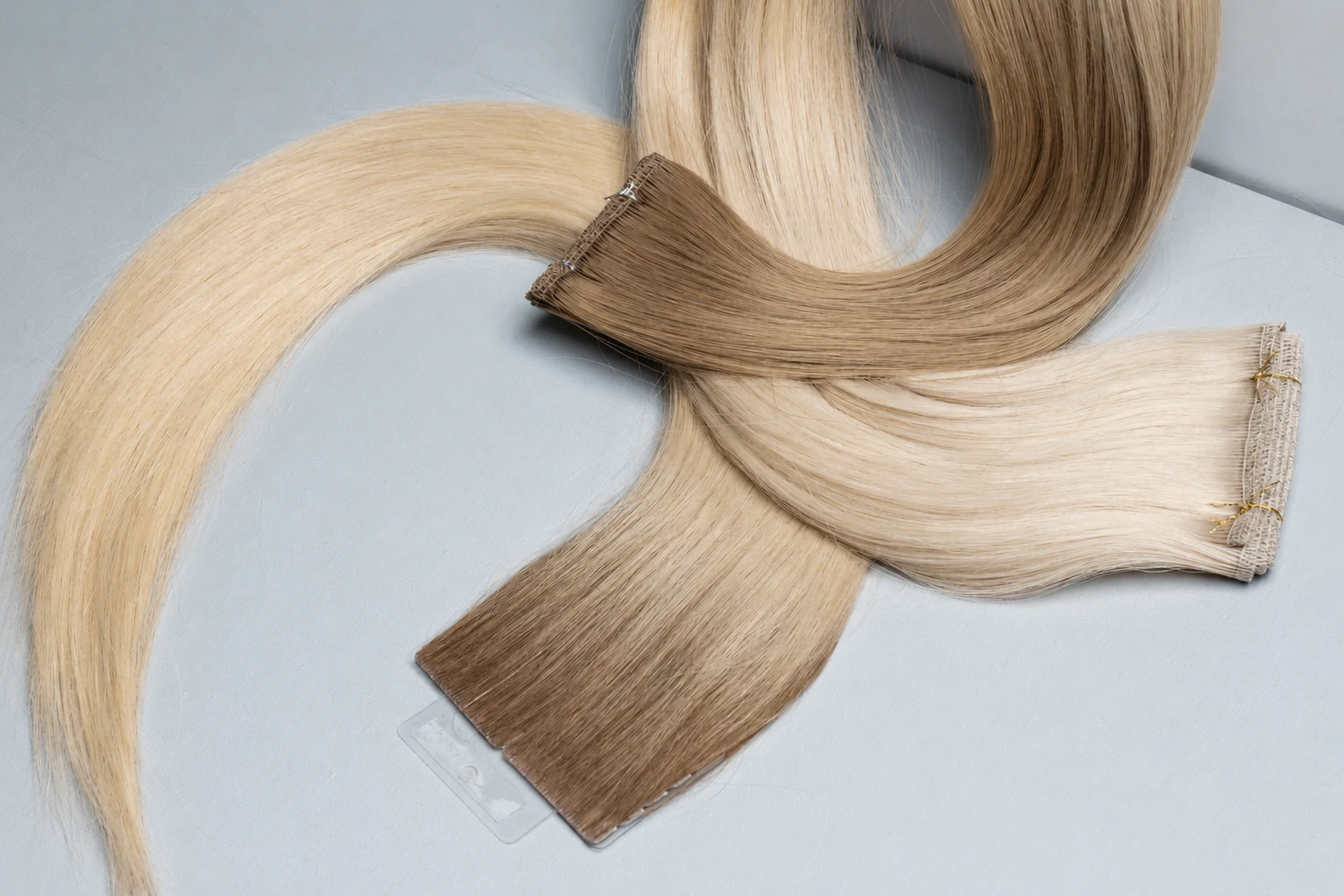
For example, a brand may choose a standard Tape-In structure but customize:
- Virgin or Remy hair requirements.
- Length, weight, fullness, and texture.
- Shade, root, highlight, or balayage effect.
- Tab dimensions, adhesive, PU finish, or other construction details.
- Labels, color codes, inserts, barcodes, and retail packaging.
As a result, the project may be OEM, ODM, and private label in different respects. Ask which decisions belong to the brand, the manufacturer, or both.
What Is OEM Hair Extension Manufacturing?
Under an OEM-style project, the buyer controls the requirement and the manufacturer turns it into repeatable production. For instance, the project may start from a specification, approved sample, existing product, or measurable requirements.
The buyer’s brief may define:
- Product category and exact construction.
- Hair quality and processing requirements.
- Length, weight, texture, and long-hair ratio.
- Color standard and acceptable visual direction.
- Tape, weft, bond, clip, or base specifications.
- Workmanship and quality-control requirements.
- Set composition, labeling, and packaging.
The manufacturer reviews feasibility, selects the production route, develops samples, and produces against the approved standard. In addition, the factory contributes technical knowledge; OEM does not mean the buyer must know every operation.
OEM Is Usually a Good Fit When
- An established brand already has a proven specification or retained control sample.
- The product must match an existing collection or approved performance standard.
- The buyer has a product or quality team able to make detailed approval decisions.
- Repeat-order consistency matters more than quickly selecting a standard item.
The main risk is an incomplete specification. “Premium 20-inch blonde Tape-In” leaves gaps in hair quality, fullness, shade, tab structure, weight, adhesive, and packaging. Consequently, a technically acceptable sample may still be commercially wrong.
What Is ODM Hair Extension Manufacturing?
By contrast, in an ODM-style project, the manufacturer provides more development direction. The buyer may begin with a target customer, price position, problem, reference product, or collection concept rather than a finished specification.
The manufacturer can help translate that commercial brief into a workable combination of:
- Hair quality and processing route.
- Product system and attachment structure.
- Length, weight, fullness, and texture range.
- Color palette or custom shade direction.
- Construction details and component options.
- Packaging format and presentation.
- Samples for testing and revision.
Nevertheless, the buyer still owns the approval decision. The manufacturer contributes more design, R&D, or product-configuration work, and the buyer tests and approves the final specification.
ODM Is Usually a Good Fit When
- A founder understands the target market but needs technical product-development support.
- An established brand wants a new construction, color direction, or category outside its current expertise.
- The project begins with a problem to solve rather than a complete specification.
- The buyer wants the manufacturer to recommend a manufacturable route and sample options.
ODM usually involves more shared decisions and sample iteration than a standard product. Therefore, plan timing around the hair, color, construction, components, packaging, feedback, and revisions—not a universal timetable.
What Are Private Label Hair Extensions?
Private label means the buyer sells the hair extensions under its own brand. For example, the scope may include product naming, color codes, labels, barcodes, care information, inserts, boxes, sleeves, bags, and carton identification.
Private label does not automatically tell you how customized the hair or construction will be. A private-label project may use:
- Standard factory products with branded packaging.
- Existing constructions with customized hair, color, weight, or length.
- Buyer-supplied OEM specifications.
- Jointly developed ODM products.
However, the phrase does not automatically guarantee exclusivity. Address product exclusivity, territory, ownership of custom designs, color standards, tooling, packaging files, and confidentiality separately in the commercial agreement.
Epoche’s hair extension manufacturing solutions support product specifications, sample development, OEM manufacturing, color and construction customization, branded packaging, and repeat-production control. In each case, the brand’s existing assets and development gaps determine the correct scope.
What Is White Label in Hair Extensions?
By contrast, white label starts with a standardized product that multiple businesses may sell under their own brands, with limited choices such as stock colors, lengths, labels, or packaging.
As a result, it can reduce development work and help validate demand without creating a unique construction. However, the buyer accepts less differentiation and product control.
Private label and white label are sometimes used interchangeably, but the practical distinction is customization. A white-label product is generally more standardized, while private-label work can involve a more brand-specific product and presentation. Therefore, the quotation should list the allowed product and packaging changes.
OEM vs ODM vs Private Label vs White Label
| Decision factor | OEM | ODM | Private label | White label |
|---|---|---|---|---|
| Starting point | Buyer specification, control sample, or defined requirements | Buyer’s market brief or product goal plus manufacturer-led development | A product that will carry the buyer’s brand | A standardized manufacturer product |
| Product control | High buyer control when the specification is complete | Shared during development; buyer approves the final standard | Varies from standard to fully customized | Usually limited to available options |
| Manufacturer’s development role | Feasibility, sampling, production engineering, and manufacturing | Concept translation, structure or range proposals, development, sampling, and manufacturing | Depends on whether the project is OEM, ODM, or standard | Limited development because the platform already exists |
| Hair and construction customization | Defined by the approved OEM brief | Developed jointly from the buyer’s goals | Can range from minimal to extensive | Usually limited |
| Branding and packaging | Optional and separately defined | Optional and separately defined | Central to the model | Usually branding applied to a standard product |
| Best suited to | Brands with defined products and approval capability | Brands needing product-development support | Any brand that wants products sold under its own identity | Buyers prioritizing a simple market entry over product differentiation |
| Main risk | Gaps or contradictions in the buyer’s specification | Unclear approval authority or uncontrolled revisions | Assuming branding includes product uniqueness or exclusivity | Limited differentiation and dependence on a shared product platform |
However, this table describes common operating patterns, not universal legal definitions. The signed specification, sample approval, quotation, and agreement determine the real relationship.
Which Model Fits Your Brand?
Choose OEM When You Know Exactly What Must Be Reproduced
OEM suits a successful product with a technical brief, approved color system, and clear quality requirements. Therefore, greater control also requires stronger specification discipline.
Choose ODM When You Know the Market Need but Not the Final Product
ODM suits a clear commercial opportunity whose construction, materials, color route, or range still needs development. The manufacturer helps convert the idea into an approvable standard.
Choose Private Label When Brand Presentation Is Essential
Choose private label whenever you will sell the product under your identity. Then decide separately whether the underlying product is standard, OEM, or ODM.
Choose White Label When Speed of Range Validation Matters More Than Exclusivity
White label can be practical for testing a category with limited development. However, do not present it as a unique custom product unless the agreement provides unique specifications or exclusivity.
A Hybrid Model Is Often the Most Practical
In practice, many projects do not need to be fully standard or fully custom. A hybrid route can preserve control where it matters while avoiding unnecessary development.
Examples include:
- An approved standard weft construction with custom color, length, weight, and packaging.
- A proven Tape-In platform with a buyer-specific fullness profile and color collection.
- A standard Keratin Tip shape with customized bond color, portion weight, and branded presentation.
- An existing Clip-In base adapted to the buyer’s set composition, clip layout, shade range, and packaging.
Therefore, the brand should identify which features create real customer value. Customizing every detail adds approval work and operational complexity; customizing nothing makes differentiation difficult.
What Affects Development Work, Timing, and Order Requirements?
No single MOQ or lead time applies to every OEM, ODM, or private-label hair extension order. The manufacturing model is only one factor. Project requirements can change with:
- Raw-hair quality and availability.
- Custom colors, roots, blends, or texture development.
- New attachment structures, dimensions, molds, or components.
- Length, weight, fullness, and SKU count.
- Testing and sample-revision rounds.
- Custom packaging quantities, print methods, and component suppliers.
- Artwork readiness and required market-specific labeling.
- Production scheduling and order composition.
A useful quotation should separate product development, samples, bulk products, packaging, and special components. In addition, it should list confirmed items, pending approvals, and changes allowed after sample testing.
What Should You Prepare Before Contacting a Manufacturer?
You do not need a complete technical specification to start an ODM discussion. However, clearer information produces a more relevant proposal.
Prepare:
- Target customer, market, price position, and sales channel.
- Current product or proposed extension categories.
- Hair quality, color, texture, length, weight, and fullness expectations.
- Reference products, physical samples, color swatches, or problem examples.
- Required construction or performance characteristics.
- Initial SKU plan and expected purchasing pattern.
- Branding, packaging, barcode, insert, and labeling needs.
- Target launch window and sample-testing process.
- Which decisions are fixed and where you want recommendations.
Before sharing confidential details, confirm who will handle samples, specifications, files, and development information and how they will protect them.
Questions to Ask Before You Choose the Model
Ask the manufacturer:
- What does OEM, ODM, private label, and white label mean in your quotation?
- Which product details can your factory customize, and which use existing standards?
- Who prepares the specification, samples, packaging files, and approval records?
- Which physical sample or document becomes the bulk-production standard?
- Are any products, colors, structures, or territories exclusive? Where is that written?
- Who owns custom artwork, tooling, color references, or product-development files?
- What changes require new sampling, pricing, or approval?
- Which MOQ and timing conditions apply to the product, packaging, and special components separately?
- How does your team retain approved specifications for repeat orders?
- What happens if a sample fails testing or the project scope changes?
Common Mistakes to Avoid
- Choosing a supplier because it advertises “OEM/ODM” without defining the service scope.
- Assuming private label automatically means a unique or exclusive product.
- Requesting an OEM quotation without a usable product specification.
- Expecting ODM development while providing no target customer, positioning, or approval criteria.
- Approving packaging before the final product dimensions and set composition are stable.
- Comparing prices when suppliers have quoted different hair, construction, customization, or packaging scopes.
- Starting bulk production before the approved sample and specification are clearly connected.
Choose the Scope, Not Just the Acronym
OEM gives the buyer greater control when the product is already defined. By contrast, ODM adds manufacturer-led development when the destination is clearer than the technical route. Private label gives the collection the buyer’s identity and can sit on top of either model. Finally, white label offers a more standardized starting point with less development and differentiation.
The right model matches your product knowledge, approval capability, differentiation goals, budget structure, and launch plan. Therefore, define the scope in the specification, quotation, sample record, and commercial agreement so both teams use the same meaning.
To evaluate the right combination of product development, customization, packaging, and repeat manufacturing for your collection, discuss your project with Epoche.